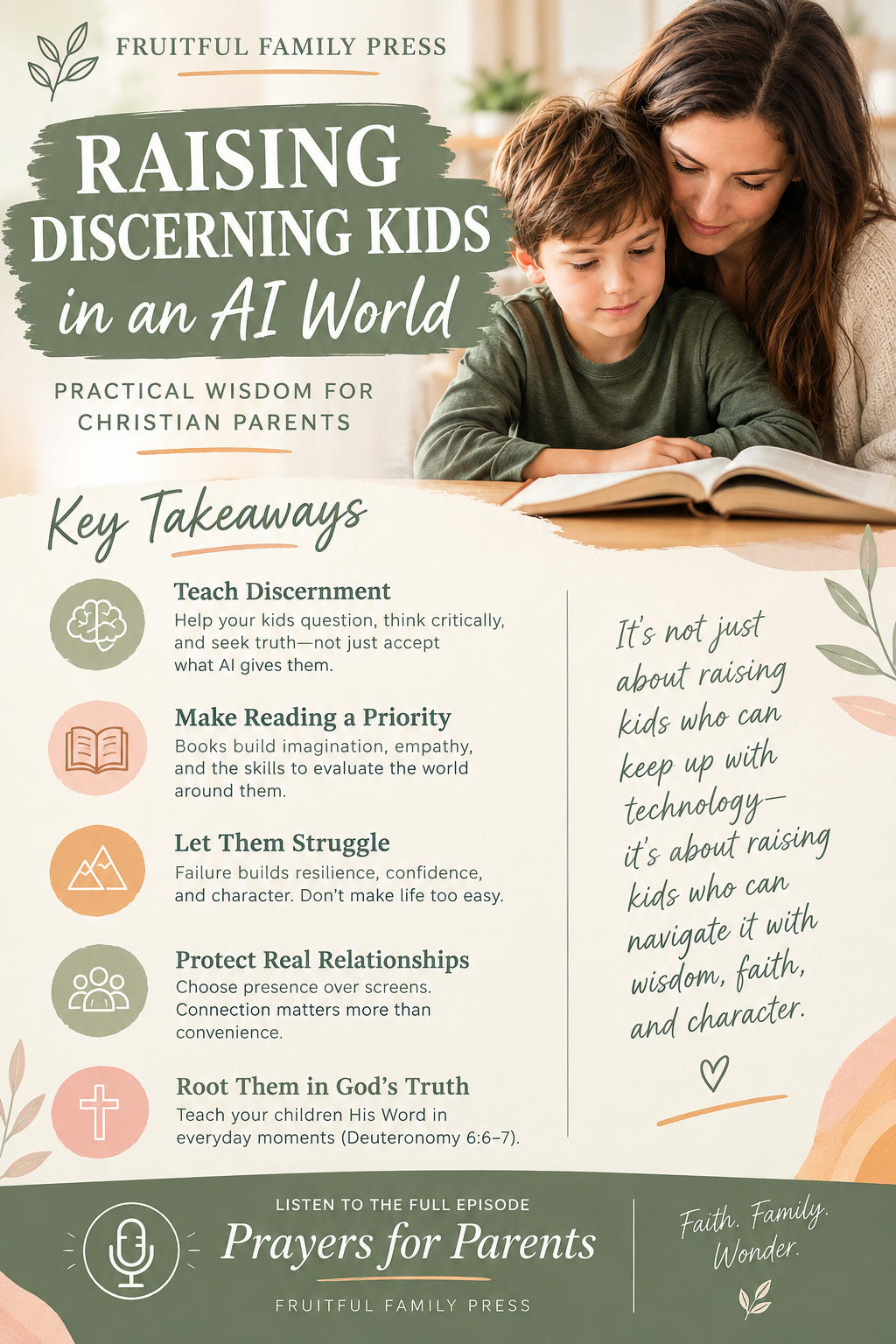
Artificial intelligence is changing the world our children are growing up in. From AI-powered homework tools to automated writing assistants and personalized digital experiences, technology is making information more accessible and everyday tasks easier than ever before.
But as Christian parents, we have an important question to consider: Just because technology can make something easier, does that mean it is always good for our children?
How do we raise children who can think critically, recognize truth, build meaningful relationships, and exercise biblical discernment when technology can do so much of the thinking for them?
These are some of the questions I explored in a recent conversation with P.J. Singleton, author of The Woven and founder of Anchor Point Publication House, on the Prayers for Parents: Liturgies for Home and Family podcast.
Our conversation challenged me to think more carefully about the relationship between technology, human development, Christian parenting, and the experiences that shape our children's character.
Here are some of the most important takeaways for parents raising children in an increasingly digital world.
1. Artificial Intelligence Is a Tool, but It Shouldn't Replace Our Judgment
One of the most helpful distinctions P.J. made during our conversation was that artificial intelligence is not inherently good or evil. Like many other technologies, AI can be used for beneficial purposes, but it also introduces risks that require wisdom and discernment.
AI can help us organize information, check spelling, analyze complex material, and complete certain tasks more efficiently. These can be valuable uses of technology.
The challenge comes when we stop evaluating the results ourselves.
P.J. explained that he uses AI in his professional work and has taught his children to use AI tools, too. He sees their potential, but he also recognizes the importance of retaining human judgment.
His guiding principle was simple: let AI assist with editing and evaluating ideas, but don't let it become the creator.
That distinction has significant implications for Christian families.
There is a difference between using AI to help organize our thoughts and asking it to do all our thinking for us. There is a difference between using a tool to check our work and allowing that tool to determine what we believe.
As our children gain access to increasingly sophisticated technology, we need to teach them more than how to use it. We need to help them understand when to use it, when to question it, and when to set it aside.
The goal isn't simply to raise technologically capable children. It's to raise wise children who know how to exercise discernment.
2. Christian Parenting in the Digital Age Requires Teaching Discernment
For generations, parents have taught their children to distinguish between right and wrong, truth and falsehood, wisdom and foolishness.
Artificial intelligence doesn't eliminate that responsibility. In some ways, it makes that responsibility even more important.
P.J. pointed to Deuteronomy 6:6–7, which instructs God's people to keep His commandments on their hearts and teach them diligently to their children throughout the rhythms of everyday life.
These words, which I am commanding you today, shall be on your heart. You shall teach them diligently to your sons and shall talk of them when you sit in your house and when you walk by the way and when you lie down and when you rise up.
The passage gives us a picture of discipleship that happens continually—not simply during a designated Bible lesson, but throughout the ordinary moments of family life.
That principle matters when it comes to technology, too.
We can't expect our children to develop discernment simply by telling them which technologies are acceptable and which ones are not. They need opportunities to practice evaluating information, asking thoughtful questions, and considering the consequences of their choices.
P.J. offered an interesting observation: when information becomes instantly accessible, memorizing facts alone is no longer enough. Children also need to develop the wisdom to interpret what they find.
An AI tool might quickly locate Bible verses related to a particular subject. But finding a verse is not the same as understanding its context, interpreting Scripture faithfully, or applying biblical truth wisely.
Likewise, an AI-generated answer may sound convincing without being accurate.
Our children need to learn to ask questions such as:
Is this information true?
What evidence supports this claim?
Does this reflect what Scripture teaches in context?
What assumptions might be shaping this answer?
Am I using this tool to help me think, or am I allowing it to think for me?
These are not merely technology skills. They are important components of biblical discernment.
As Christian parents, our task is to cultivate children who love truth enough to examine what they hear rather than simply accepting whatever sounds persuasive.
3. Reading Helps Children Develop Wisdom and Critical Thinking
One of P.J.'s strongest recommendations for raising discerning children was surprisingly simple: encourage them to read.
Reading is not simply a way to acquire information. It helps children develop language, recognize context, follow complex ideas, understand different perspectives, and notice details that might otherwise escape them.
These abilities become particularly important in a world where AI can produce polished, confident-sounding answers in seconds.
A child who has developed strong reading comprehension and critical thinking skills is better equipped to evaluate the information presented to them.
Reading also gives children opportunities to encounter ideas that challenge them, wrestle with difficult questions, and consider the motivations and consequences of human choices.
This is one reason meaningful literature can be such a valuable resource for Christian families.
P.J. described his love for literary fantasy, including the works of C. S. Lewis and J. R. R. Tolkien. He also discussed how fiction can explore complicated questions about humanity without turning every chapter into an explicit moral lesson.
Stories allow children to encounter ideas through characters, relationships, conflicts, and consequences. Instead of simply being told what to think, young readers can observe what happens when people make certain choices.
For Christian parents, this creates opportunities for thoughtful conversations about truth, courage, friendship, responsibility, and faith.
Some books worth exploring with older children include:
The Screwtape Letters by C. S. Lewis
The Lord of the Rings by J. R. R. Tolkien
The Wingfeather Saga by Andrew Peterson
The Pursuit of God by A. W. Tozer, particularly for older teens ready for more challenging theological reading
Of course, the best reading choices will depend on your child's age, maturity, reading ability, and interests.
The broader point is that reading helps build the intellectual and imaginative foundations children need to evaluate the world around them.
If we want our children to recognize truth, we should help them develop the habits of mind that make discernment possible.
4. What Do Children Lose When Technology Makes Everything Easier?
One of the most thought-provoking themes in our conversation was the cost of convenience.
We live in a culture that continually looks for ways to eliminate friction. We want faster checkout processes, instant answers, automated tasks, and solutions that require less effort.
Often, these developments are genuinely helpful. There is nothing inherently wrong with making an unnecessary task more efficient.
But what happens when we begin eliminating the very challenges that help us grow?
P.J.'s book, The Woven, explores this question through the fictional city of San Lorio, a technologically advanced society in which an artificial intelligence called the Weave anticipates people's needs and makes life remarkably convenient.
The system is not portrayed as an obvious villain. It is designed to help people. It genuinely seeks to care for them.
Yet the story explores what happens when that pursuit of convenience begins to remove the imperfect, difficult, and deeply human experiences that give life meaning.
One example involves a baker whose bread is altered by an automated system to make it more consistent. The system improves the product according to its own standards, but something meaningful is lost in the process.
The baker's particular recipe, the character of the bread, and the experience of making something in a distinctive way all matter. What appears to be an improvement from a technical perspective becomes a loss from a human perspective.
That example raises an important question for parents: Are we always improving our children's lives when we make things easier for them?
Consider the ways this question applies to childhood.
When children struggle to solve a problem, they learn to persist. When they work through a disagreement with a friend, they practice humility, communication, and forgiveness. When they attempt something difficult and fail, they discover that failure is not the end of the story.
These experiences may be uncomfortable, but discomfort is not always harmful.
Sometimes, the difficult part is where the growth happens.
Technology becomes a concern when convenience stops serving human flourishing and begins replacing the experiences through which children develop the skills they need to flourish.
5. Children Need Safe Opportunities to Fail
As parents, it can be difficult to watch our children struggle.
We want to protect them from disappointment, frustration, embarrassment, and unnecessary hardship. When we have the ability to make a task easier or solve a problem for them, it can feel natural to step in.
There are certainly times when intervention is necessary. Children need protection, support, instruction, and appropriate accommodations.
But there are also times when our children need room to try, struggle, make mistakes, and learn.
P.J. argued that Christian parents should intentionally create safe opportunities for children to experience failure.
He offered the example of planning a family outing. Rather than making every decision ourselves, we might give our children a budget, access to relevant information, and a few parameters, then allow them to help plan the experience.
Perhaps their plan doesn't work perfectly. Maybe they overlook something important, misjudge how long an activity will take, or discover that their original idea isn't as practical as they thought.
Those moments provide opportunities to learn.
Children can discover that mistakes are survivable, that plans can be adjusted, and that failure often provides information they wouldn't have gained through success alone.
This principle applies in countless everyday situations.
Depending on their age and abilities, children might:
Help plan a family meal and learn what happens when ingredients are forgotten.
Work through a challenging puzzle without immediately receiving the answer.
Attempt a new skill that requires repeated practice.
Participate in resolving an age-appropriate disagreement.
Help plan an outing and adjust when the original plan doesn't work.
Complete a challenging assignment with support rather than having an adult do it for them.
The goal is not to manufacture distress or leave children unsupported. It is to provide meaningful challenges within an appropriate level of safety and guidance.
We want our children to know that difficulty is a normal part of life, that mistakes can be opportunities to learn, and that they are capable of growing through challenges.
When technology can generate answers, write assignments, and solve problems almost instantly, these experiences become especially valuable.
Our children need opportunities to develop the confidence that comes from doing difficult things themselves.
6. Human Relationships Matter More Than Digital Convenience
Another major theme of our conversation was the importance of relationships.
Technology can connect people across great distances, provide useful tools for communication, and help us stay in touch. But digital interaction can also crowd out the face-to-face connection that human beings need.
P.J. shared his concern about how much time young people spend interacting with others in person and how easily families can become physically present but relationally disconnected.
He even described the familiar experience of sitting together as a family while everyone looks at a separate phone.
We've probably all experienced some version of this.
We can share a room without sharing our attention. We can sit at the same table while mentally inhabiting entirely different worlds.
The question is not whether every family needs identical technology rules. The question is whether our habits are supporting the kind of relationships we want our families to have.
From a Christian perspective, relationships are not incidental to human flourishing. We are created in the image of a relational God and called to love our neighbors, serve one another, forgive, and live in community.
These qualities are cultivated through actual relationships, with all their inconveniences and imperfections.
Children need opportunities to listen, notice another person's emotions, work through misunderstandings, and learn how to respond when someone disagrees with them.
They need the experience of being fully present with another person.
That means our family's technology habits deserve intentional consideration.
Here are a few practical ways to protect relational connection at home:
Create phone-free family rhythms. Meals, bedtime routines, family devotions, and other shared activities can become natural opportunities to put devices away.
Model the habits you want your children to develop. Our children notice when we interrupt conversations to check notifications or reach for our phones whenever we have a spare moment.
Make room for unstructured interaction. Not every quiet moment needs to be filled with entertainment or digital stimulation. Children can benefit from opportunities to play, talk, create, and simply be together.
Prioritize face-to-face relationships. Digital communication can supplement relationships, but it should not automatically replace opportunities for meaningful in-person connection.
Talk about technology rather than relying only on rules. Help children understand why your family makes certain choices and invite age-appropriate conversations about what technology gives and what it might take away.
These practices do not require a perfect household or a completely technology-free life. They require intentionality.
The goal is to make sure our tools remain servants of our relationships rather than becoming competitors for our attention.
7. How Can Christian Parents Teach Children to Question What Looks Good?
Perhaps the most important question from our conversation was this: How do we help our children recognize that something can look good, promise to solve their problems, and still not be good for them?
This question extends far beyond artificial intelligence.
Children encounter appealing ideas, products, relationships, and opportunities throughout their lives. Some are beneficial. Others may be harmful despite their initial appeal.
If we want our children to make wise decisions as adults, we cannot rely solely on telling them which choices to make.
They need to develop the ability to evaluate choices for themselves.
In The Woven, the children begin to notice what the seemingly perfect system is smoothing away. They develop a way of recognizing when convenience comes at the expense of something meaningful.
P.J. described this as learning to notice what has been lost in the pursuit of a frictionless life.
For parents, that idea provides a helpful framework for conversations about technology and many other areas of life.
When a tool promises to save time, we can ask what that time will be used for.
When an app promises to make communication easier, we can consider whether it is strengthening relationships or replacing more meaningful forms of interaction.
When a shortcut promises an effortless result, we can ask whether the process itself is important to our growth.
And when a technology offers to make a decision for us, we can consider whether that decision is something we should be practicing ourselves.
These questions help children move beyond simply asking, "Can I do this?" or "Will this work?"
They begin asking, "Is this wise?" "What are the consequences?" and "What kind of person am I becoming through this choice?"
Those are important questions for Christian discipleship.